
Business Continuity for Hurricane Season: A South Florida IT Readiness Plan
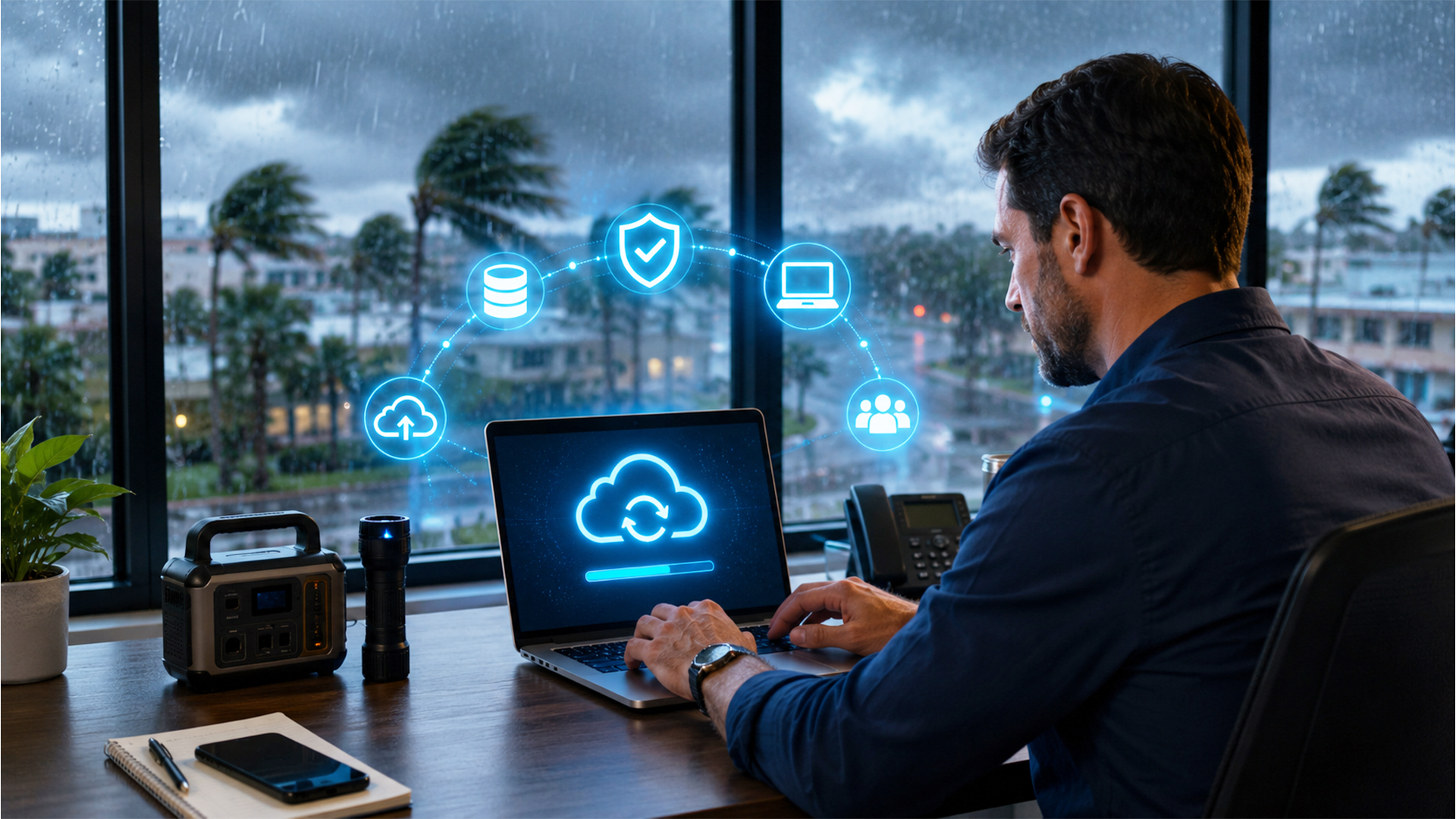
The forecast turns, the office loses power, and your business stops.
For companies across West Palm Beach and the rest of South Florida, that scenario is not hypothetical, it is a yearly event. The businesses that recover fastest are rarely the ones with the newest equipment. They are the ones with a tested plan in place before the storm ever forms.
This guide covers the strategy: how to structure continuity so your business keeps running before, during, and after a storm.
Quick Answer
- Business continuity planning means keeping systems, data, and communication running before, during, and after a hurricane.
- A solid plan covers data backup, remote access, failover connectivity, and clear staff communication.
- South Florida businesses should finalize readiness before June 1, when hurricane season officially begins, not scramble once a storm is named.
- Cloud-hosted systems and off-site backups are what keep operations running when a physical office loses power or access.
- An MSP can manage this plan year-round so it is ready the moment a storm watch is issued.
Why Continuity Matters More Than Equipment
A single day of downtime can cost a small business thousands in lost revenue, missed deadlines, and frustrated clients. Hurricane season runs from June 1 through November 30, per the National Hurricane Center, and even a storm that never makes direct landfall can knock out power and connectivity for days.
Clients do not pause for weather.
- Deadlines and client expectations continue whether or not your office has power.
- Competitors who stay online during a storm often keep the business that goes to whoever answers the phone.
Planning ahead is what separates a short disruption from a week of lost operations.
Hurricane Risks, Downtime Costs, and Compliance Exposure
The risk goes beyond a downed power line. Flooding, connectivity loss, and physical damage to on-site servers all threaten the same thing: access to your data.
- On-site servers are vulnerable to flooding, power surges, and physical damage.
- Extended outages can violate service level agreements with your own clients.
- Healthcare and financial businesses face compliance exposure if client data becomes inaccessible or unprotected during an evacuation.
A readiness plan has to account for the physical building being unreachable, not just the internet going down. Federal resources like Ready.gov’s business continuity guidance reinforce the same point: continuity is about data and people, not the office itself.
MSP-Backed Continuity and Disaster Recovery
This is where a managed IT partner earns its keep. The right setup means your team can keep working from anywhere power and the internet exist, even if that is not your office.
- Cloud hosting keeps applications and files reachable from any location.
- Automated, off-site backups protect data even if on-site hardware is destroyed.
- Remote access tools let staff work securely from home or a temporary location.
- 24/7 monitoring flags problems the moment they start, rather than after a client calls in.
None of this works if it is set up after the storm warning goes out. It has to already be running. QIT builds this on our backup and disaster recovery services and cloud hosting solutions.
What a Storm-Ready IT Environment Looks Like
A hurricane-ready environment relies on the same discipline used for any disaster recovery plan, applied on a South Florida timeline.
- Documented recovery time objectives (RTO) and recovery point objectives (RPO) for every critical system.
- Redundant internet connections or cellular failover for locations that cannot afford to go dark.
- A communication tree so staff, vendors, and clients know how to reach the business if phones go down.
- An annual test of the full recovery plan, not just a policy sitting in a drawer.
The Cost of Being Unprepared
Businesses that wait until a storm is named are often improvising decisions that should have been made months earlier.
- Emergency data recovery after physical damage costs far more than proactive backup and cloud hosting.
- Missed client deliverables during a storm can mean lost contracts long after the weather clears.
- Reactive scrambling under a deadline increases the odds of a mistake that causes a second outage.
The cost of readiness is a fraction of the cost of recovery.
A Readiness Plan Built on the Storm Calendar
Generic disaster-recovery steps do not match how hurricane season actually unfolds. Structure the plan around the calendar instead:
- Off-season (December to May): Move critical systems to cloud hosting, set up automated off-site backups, configure secure remote access, and run a full recovery test while there is no pressure.
- Season opens (June 1): Confirm backups are current, verify remote access for every employee, and refresh the communication tree with current contacts.
- Storm watch issued: Trigger the checklist, verify the most recent backup completed, and confirm staff know where and how they will work if the office closes. This is where thechecklist does its job.
- Landfall and aftermath: Operate from cloud and remote access while the office is offline. Monitoring continues even when the building has no power, because the systems are not tied to it.
- Post-season review (December): Compare what worked against what did not, then update the plan, the documentation, and the compliance record before the next cycle.
Why Outsourcing Continuity Makes Sense for SMBs
Building and maintaining hurricane-ready infrastructure in-house means paying for redundant systems, testing them regularly, and staffing around the clock during storm season.
- An MSP already runs this playbook across multiple clients and storm seasons.
- Cloud hosting and managed backups cost less than maintaining redundant on-site hardware.
- Support does not stop when your office loses power, since the managed systems are not tied to that building.
- You get enterprise-grade disaster recovery without hiring a dedicated infrastructure team.
How Different South Florida Businesses Stay Open
The plan looks a little different depending on what you cannot afford to lose:
- A medical practice keeps patient records reachable through cloud hosting, so care and compliance hold even if the office closes.
- A financial services firm keeps transaction systems online through cloud failover while the physical branch is shut.
- A multi-location retailer keeps point-of-sale and inventory running through cloud connectivity, avoiding lost sales during and after the storm.
- A manufacturer safeguards production and scheduling data so the floor can restart quickly once power and safety allow a return.
Serving clients beyond West Palm Beach too? The same approach carries across every market in our areas we serve, including Miami.
Frequently Asked Questions
It is a documented plan covering how a business keeps data, systems, and communication running before, during, and after a storm.
Before June 1, when hurricane season officially begins. Waiting until a storm is named leaves little time to fix gaps.
Yes. Cloud-hosted systems stay accessible from any location with power and internet, unlike an on-site server tied to one physical building.
With remote access and cloud-hosted systems in place, staff can keep working from home or another location while the office is offline.
No. Small and mid-sized businesses are often less prepared than larger ones, which makes a tested plan even more valuable.
Yes. An MSP monitors systems and storm risk continuously, making adjustments proactively instead of waiting for a client to call.
Get Storm-Ready Before the Next Watch Is Issued
Hurricane season does not give much warning once a storm strengthens. The businesses that stay open are the ones that planned months earlier.
See how our backup and disaster recovery services keep South Florida businesses running through storm season, backed by our cloud hosting solutions and managed IT services. Ready to build your plan? Reach QIT Solutions through our homepage, or call 1-844-855-4748.